About
Originally from New Zealand, of Samoan and European hertitage. Lives on Gadigal Country of the Enora nation.
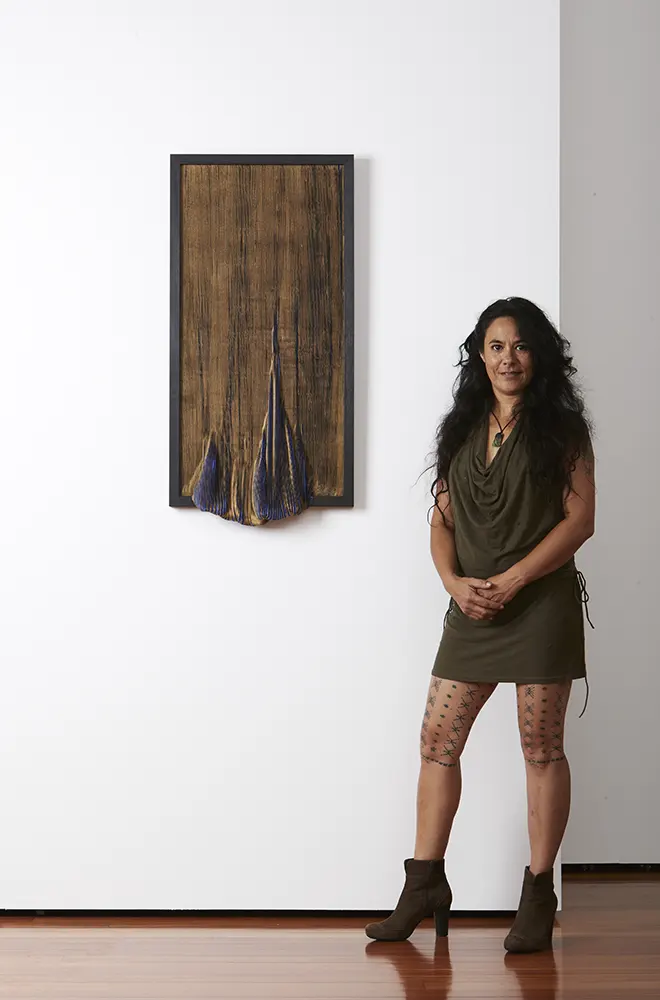
Stevie Fieldsend’s work seeks to detail an emotional state – more a
feeling or a bodily sensation. Her practice spans sculpture, wall works and installation using materials as diverse as glass, steel, textiles, stocking and charred wood.
Central to her work is the body, personal relationships, the impact of trauma and a sense of movement, of oozing, falling, coming too, going somewhere, a maturation in flux, the fissures between internal and external, a gravitational plummet and of exceeding boundaries – a transgression. That seemingly fixed states of being can in fact change given the right conditions.
Stevie Fieldsend’s work has been presented at Sydney Contemporary, Melbourne Art Fair and Art Central Hong Kong and included in curated group exhibitions at Moreton Bay Regional Gallery, Caboolture Regional Art Gallery, Campbelltown Regional Art Gallery and Art Gallery NSW. Her work can be found in numerous public and private collections, including Artbank, Macquarie Group Collection and Deloitte.
In 2022 presented a solo for The Cube Mosman Art Gallery, participated in a group show’s Polyphonic Reverb at Gertrude Contemporary, Victoria and Wonder Cupboards curated by Mikala Dwyer at MAMA Art Gallery, Albury. She is winner of Tom Bass Curators Choice, Tom Bass Prize 2022, winner of North Sydney Art Prize Sculpture Award, 2022, winner of Nerine Martini Award HIDDEN, Rookwood, 2022 and participated in Sydney Contemporary with Artereal Gallery.
In 2023 she participated in group show’s Present Continuous at Sydney College of the Arts, Nuova Luce at Artereal Gallery, CUT N POLISH 2023 at CarriageWorks and a finalist at Wangaratta Contemporary Textile Award. Fieldsend will present her solo Lush Eruptions at Post Exeter space curated by Diana Palmer in September 2024.
Recently Fieldsend was invited to reimagine P&O Ceramic Wall Mural by Douglas Annand in consultancy with Mikala Dwyer and collaborated on crystal element for the Shelter of Hollows by Mikala Dwyer curated by Felicity Fenner for the Macquarie Group and Sydney Metro project. The new Sydney Metro Martin Place integrated station precinct 2024.
In working with materials that embody the process of transmutation such as molten glass, steel and charred wood, a type of performance takes place close to the furnace, and inside her body. A ritual that leaves more than a trace, it leaves a place of where there is a possibility of transformation.